Synopsis to
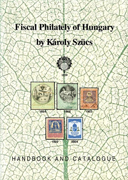
Fiscal Philately of Hungary by Károly Szücs
5th edition: Budapest 2018 by the author first in English
About 400pp A4 size 297x210mm, profusely illustrated in full colour, perfect bound.
Available at the www.darabanth.hu for price 80 Euro plus shipment
This book has been produced first in 2007 over several years by many authors, an enthusiastic group of members of MABÉOSZ's Revenue Stamp collectors' group in Hungarian. The 4rd edition is hardly extended by one of the authors and was published in May of 2017. 120 new pages were added with information of latest research in the past decade in this hardly developing philatelic field. At the end, the first English edition appears in 20 of June 2018 exactly on the day of 150 anniversary of issue of the first Hungarian adhesive revenue stamps. It was long awaited by the foreign collectors and lover the Hungarian revenue philately!
It was originally envisaged as a revision of the late Floderer István's 1991 catalogue of Hungarian revenues but has grown to be much more than that. Indeed, it covers more than just Hungarian material – as the title suggests, all the Habsburg issues used in Hungary(Hungary, Austria, Bosnia & Herzegovina, the Military Border District and the WWI occupations) – are included). And not just the adhesive stamps, the pre stamp 'Signettes' on stamped paper from 1850 are also listed and illustrated, as are the newspaper tax, calendar and other special purpose imprints and adhesives. In addition, all the post WWI Hungarian stamps are fully listed, again in considerable detail and beautifully illustrated in full colour. The listing of the interesting and attractive Hungarian municipal revenue stamps alone runs to over 100 pages. In fact the only major topic in Floderer's book which isn't fully reworked and included here is the revenue stationery (parcel cards, bills of lading, hunting permits, bills of exchange and so on.) They appear only in Hungarian recently in another new books.
Of course, there was the drawback that much of the explanatory text (and there is a huge amount of information given, throughout the book) was pretty impenetrable for the non Hungarian speaker. Fortunately, the recent first English edition was selfless supported by selfless sponsors from England and Hungary. The author has obviously given much thought in making the book as 'user friendly' as possible and there are a multitude of helpful diagrams, charts, tables and yet more illustrations included. There is also a brief vocabulary and key to symbols and abbreviations included, in Hungarian, English & German.
The author has also bravely priced everything (in Euros), including varieties and valuation of the stamp on document. Quantities issued are noted where known. Naturally, the prices sometimes give rise to incredulity – in some cases for their cheapness, in others for their apparently high valuations. Surely, the author has done their best to coax other collectors to assist them in estimating scarcity. The market for revenues in Hungary is probably more developed than in some other countries and there is a lot of material about (there always seems to be a good selection on eBay, for example). But there are lots of very rare items listed and they can fetch hundreds of pounds on the very few occasions one appears at auction. It won't be long, before they will be fetching thousands.
If you are at all seriously interested in Hungarian (or Austrian) revenue philately, then this book is absolutely indispensible.
Actualised by the author of original review in 2007 written by Martin Brumby Chairman of Austrian Philatelic Society in Great Britain
Book Review – Fiscal Philately of Hungary
This writer and student of the postage stamps and markings of the world has been busily dedicated to this gathering and study for more than a half century. Unlike most philatelists, I have also had an intense interest in the same pursuit of the fiscal stamps et relata for 64 years. I have seen some of the finest pieces of scholarship and collaboration on literature that has come to print. Armed with this background, I approached the book, Fiscal Philately of Hungary, confident that it would be a challenging buteasily performed task to hopefully recommend Mr. Karoly Szücs's book to all collectors and students of the fiscal stamps of Hungary.
As I scrolled down the text on my computer to get my first overall feel of the size and density of it, it was immediately clear that I had never seen anything like this before. This great work catalogs, describes, classifies, brings structure to the immense quantity of extants that the fiscal system of Hungary and its predecessor, the Austro-Hungarian Empire, into an accurate focus. Only the mind/minds of great collectors lead by the supreme collector could have assembled it. It was
onestly, as we say in my native tongue (American English) "staggering."
The research area it comprised was comprehensive. Accordingly, the book includes in its work not just the federal taxation system, but also the stamps and documents of the many taxation systems locally instituted by the various agencies of that great country. In short, there is no question in my mind that the fiscal "philately" of Hungary has been arranged and beautifully arrayed in both its breadth and its depth to the eyes and minds of those fortunate enough to behold it.
So, when I say that this great work is a "must have" for any collector of tax stamps, I do not do so lightly. It is indeed a true paradigm for research and cataloguing of all fiscal stamps, markings and documents any student(s) to have access to. If as human beings we are truthful, few things have been pursued with more vigor by governments than the taxation of the citizens of this world. So, to have in one volume work of this prodigious and telling a kind is not just an honor and a pleasure, but a blessing to witness and to use.
Therefore, I salute Mr. Karoly Szucs and his great circle of friends who have established themselves as a new proud part of the assessment of the fiscal history of his great nation of the highest order.
19 June 2018
George Luzitano, Ph. D,
member of Society for Hungarian Philately in the USA
Email: www.hungarianphilately.org.
----------****-----------
Dear Collectors, Dealers, and those interested in Baden's history, following many years' research and study, we are pleased to announce the publication of the second book in our German fiscal philately series, namely: "Stamp Duty Statutes, Rates and Application in Baden 1628-1952: Baden Fiscal Philately Handbook and Catalogue"
Published by Engelsdorfer Verlag, Schongauerstr. 25, 04329 Leipzig, Germany, and available through book-dealers and other stockists at the retail price of 49,95 Euros. 660 pages, around 770 colour illustrations, offset printed, sewn hardback binding (ISBN 978-3-95744-583-4).
The handbook provides a historical outline of taxation and stamp duty applied to revenue stamped paper, Playing cards, Almanacs, Newspapers, and Baden's revenue stamps, sales tax stamps, judicial fee stamps, and municipal fee stamps. The stamp listings are supported by a detailed assembly of extracts and examples of Baden's statutes and taxation rates, together with a listing of Baden's municipal authorities between 1910 and 2010, an overview of Baden's administrative and judicial history, and a bibliography.
Main text is in German, plus English-speaking readers will find a summary and listing of contents, and translations of philatelic terms.
Naturally the authors are aware that further contributions of information will be offered by collectors as a result of the publication of this book. Updates will appear at from time to time on the homepage of Wolfgang Morscheck (www.fiskalvorpost.de, www.fiskal-philatelie.de or www.stempelpapier.de).
The first book in this series already appeared from the same publisher in March 2012, providing similar coverage of the fiscal philately of Saxony (ISBN 978-3-86268-730-5), publication price 21,00 Euros, with specialist chapters also by Wolfgang Morscheck of Bad Säckingen and Dr. Hans-Dieter Lutz of Villingen-Schwenningen.
This Baden Handbook, and also the similar Saxony handbook which appeared in 2012, may both be ordered from the authors listed below, by payment in advance, for the total retail price of any or all books ordered, plus postage
(up to 5 kg, 2 books): - Germany post free
- Europe Union 16,99 Euros
- Europe 29,99 Euros
- Canada, USA 35,99 Euros
- Worldwide 42,99 Euros
or though book dealers and other stockists.
Leipzig, March 2015 Bad Säckingen, March 2015 Filderstadt, March 2015
Steffen Eckert Wolfgang Morscheck Gunter Wagner
Färberstr. 9 Rudolf-Graber-Str. 6 Rosenapotheke
Nürtinger Str. 4
04105 Leipzig 79713 Bad Säckingen 72649 Wolfschlugen
E-Mail: eckertsteffen@t-online.dehausin.morscheck@signette.deinfo@rosen-apotheke24.de
----------****-----------
El PapelSellado en Colombia 1640 - 1981 By Manuel Arango Echeverri
Three volumen, 2.120 pages , Format: 21 x 25 cm
Our Secretary, Jukka Mäkinen, us make known the magnificent work that summarizes over 15 years of research and compilation of material by our dear Colombian friend Manuel Arango Echeverri. Manuel was given the task of wandering around almost all the historical archives of Colombia; work has finally been captured in this beautiful work, presented in three volumes.
The book is a journey through a deep and detailed study of stamped paper used in Colombia since its inception in 1640 until 1981, when by force of law became extinct as a direct tax. Author's Note"For a long time by I tried very hard with different governmental and business circles to help me with the publication of this research. It was not possible. So, I finally decided to do it on my own. I bought a professional laser printer and I did the work on my house. It takes me about seven hours to print 2130 pages and then somebody else takes care of the plastering. Just print on request. Of a planned 50 books I have printed already 35, including donations to History and the other few that I sold. It is therefore very expensive. The price is U.S. $ 250 plus shipping via UPS or Fedex, (about $ 120, depending on the destination). Please be aware that the book is written in Spanish."More about his work, here!!!.
----------****-----------
Austrian Revenue Stamps: the Handbook
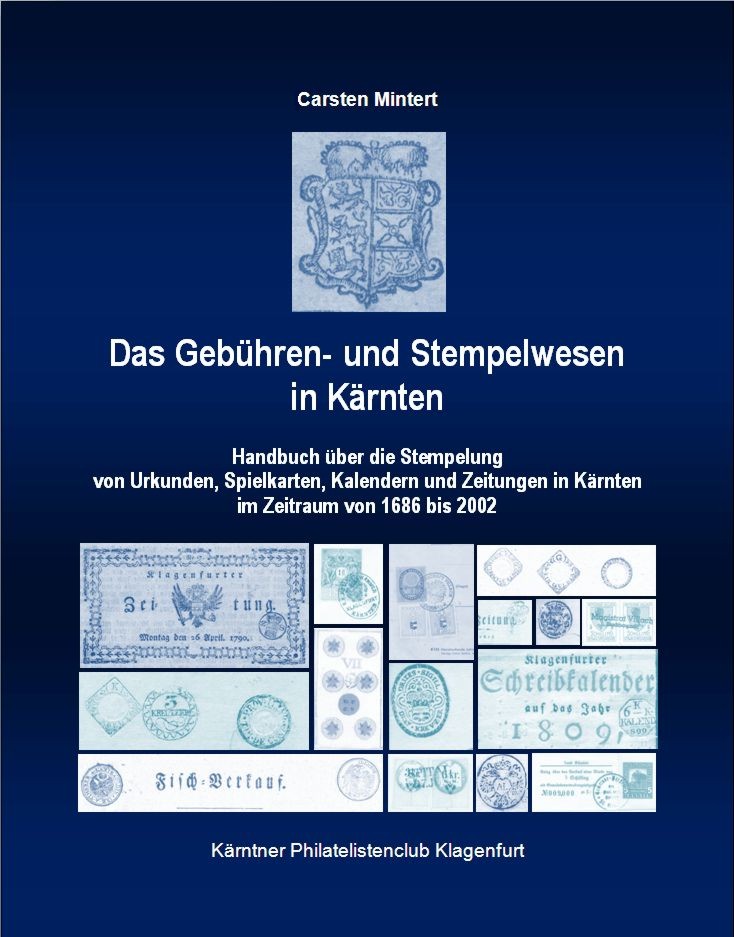
Entitled Das Gebühren- und Stempelwesen
Handbuch über die Stempelung von Urkunden, Karten, Kalendern und Zeitungen in Kärnten des Zeitraums 1686 bis 2002
Book description from The Austrian Philatelic Society (APS)
Over the last years the collecting of Austrian Revenue Stamps has become more and more popular and acceptable. Any traditional collection will be enriched by revenue stamps used as postal stamps and vice versa. But who amongst us knows the beginning and the foundation of the taxation and duties used in Austria? What different areas were used by the Austrian governance and officials during the 17th and 18th century to increase the public revenue? Everybody knows the newspaper tax stamps and the common documentary adhesive tax stamps, but just a few of us know the signets used more than 150 years before the first adhesive stamps, much less the usage and the taxation systems of these. Very attractive and almost unknown are the taxation systems for other printed items such as almanacs & advertisements. And the oldest taxation was used in Austria for playing cards – introduced in 1638.
Our APS member Dipl.Ing. Carsten Mintert has now finished a new handbook about Austrian Revenue stamps and signets, after 5 years of detailed research and consultations with other collectors and archives, and with the support of the President of the Kärntner Philatelistenclub Dr. Hadmar Fresacher. It is entitled:
The handbook design and layout is indeed new in its manner of description enhanced by the many illustrations. Although the book is written in German, the tables and the descriptions will be easily understood by non-native speakers. This handbook includes descriptions of Documentary, Playing Cards, Calendar, Newspapers, Hair-powder, Rouge and Advertisement tax stamps. Much of the material excellently described and illustrated is extremely rare and in some cases does not seem to have been previously listed at all.
And the illustrations, all in colour, are superb!
The reader will discover the historic and political background of the Austrian Taxation system as well as the handling and the importance. This book is thus the first comprehensive guide to the whole subject of fiscal philately for one of the Austrian States. The details are those applicable to Carinthia between 1686 and 2002, but very similar systems were in force in most (though not all) parts of the Austrian Empire and the book can serve as a very useful overview of how fiscal taxation developed in Austrian as a whole.
The first chapter starts with the first documentary tax stamps (called Leopolder) used from 1686. From a philatelic standpoint, the period 1742-1762 is very challenging since during it the taxation system was leased (outsourced) to tax farmers and the documents were stamped with their special (private) signets. Carinthia had its own tax office in Klagenfurt between 1762 & 1813; after 1813 all documents, newspapers etc had to be shipped to Graz and later to Laibach for the taxation. The impact caused by the French occupation in 1809 is described in detail, when the French tried (with little success) to introduce their own signets. In fact the war with the French had a impact on the province of Illyria too (to which an area of Villach belonged) and these signets are described as well. The common documentary adhesive tax stamps are not described in detail; this was not the primary intention and would go beyond the scope of this book. The focus during the time 1854-2002 is the illustration of the diversity of revenues. The last chapter describes the municipal tax stamps of the different districts of Carinthia.
Overall the book can be seen as a must for every Austrian collector and not just for a specialist in Carinthia. The book is A4 hardback printed on art-paper; 242 sides more than 250 coloured illustrations. It was published by the Kärntner Philatelistenclub Klagenfurt at 40 EUR (plus P&P) in a very limited edition.
Dear collectors, traders, and people who are interested in the Saxon history,
after years of research and collecting facts, my handbook and catalog about
Saxon Revenue Stamps
(Saxon fiscal philately)
Revenue papers, revenue stamps, fee stamps
entitled “Stempelgesetze und Gebühren
in Sachsen von 1682 bis 1952
Handbuch und Katalog”
(“Stamp Act and fees in Saxony from 1682 to 1952 - Handbook and catalog”)
is finally available.
The handbook is published by “Engelsdorfer Verlag” (Schongauer Str. 25, 04329 Leipzig, Germany) and can be purchased in book trade at a fixed price of about € 49.95. It contains approximately 466 pages and 450 colored images and is manufactured in offset printing as stitched hardcover.
€ 40.00, plus € 9,90 (European Union); € 16,90 (woldwide), postage and shipping
Along with the detailed discourse on Saxon Stamp Acts and fees including justice, municipal administration, police administration and Lutheran church with the corresponding catalog parts, the handbook contains a multitude of facts about historical persons (e.g. Prof. Max Klinger, Leopold Stentzler, Oscar Seifert, Max Ariowitsch) and about the industrial history of Leipzig, which makes it an exhaustible source for historians and museums to explore the Saxon history since 1852.
The table of contents, a summary and the philatelic terms were translated into English for the convenience of all foreign collectors.
Of course I know that it will be necessary to permanently update the book on the basis of new discoveries and information from other collectors. For everyone who buys the book, I provide therefore for an update and information service by e-mail. Interested parties may please send me their e-mail address and explicitly indicate that they are willing to participate in this update and information service. The readership will be informed on interesting new discoveries, additions, current pricing, and possible corrections.
Steffen Eckert, Account number: 1630454784
Färberstraße 9, Bank code: 86055592 (Sparkasse Leipzig
D-04105 Leipzig, BIC-Code: WELA DE 8L XXX
E-mail: eckertsteffen@t-online.de IBAN: DE 59 860555921630454784
Phone: 0049 (0)341 2334604
----------****-----------
Walter Morley’s Catalogue & Price List of the Revenue Stamps of the British Colonies,
Including Railway Stamps
Morley’s Catalogue, published in 1910, is a classic reference for those collectors who specialise in the revenue stamps of the British Commonwealth. For many years it was the only comprehensive catalogue for this material and copies, and photocopies, are still of interest despite the publication of more recent listings such as those by John Barefoot Ltd.
It is therefore a pleasure to announce that Morley’s catalogue is now available as a CD-Rom. It can be purchased from Templar House Books located in the UK at a cost of L4.99 plus packing and international airmail postage. Any orders or queries to Stephen Gardner; mail@sjgardner.co.uk.
----------****-----------
Romanian Revenue & Cinderella Catalogue
2011
The book contains 596 full color pages, in Romanian, the introductory chapter in English and Romanian. It weighs about 1,100 grams. The catalogue lists 8126 stamps as compared to 6998 in the 2006 issue. The entries for local issues have increased to 3079 from 2727 and there are 2249 digital photocopies as compared to 1668. The great increase of the number of the stamps described in this catalogue in comparison to the previous issue, confirms that this field of revenue research and collecting is alive and well.
The Catalogue has 7 parts:
- First part: Romania imprinted & embossed stamps.
- Second part: National issue.
- The third part: Local issue.
- The forth part: Jewish.
- The fifth part: The national Cinderellas
- The sixth part: The local Cinderellas
- The seventh part: Unidentified issues.
The first part includes the issues of stamped sheets.
The second part includes the majority of national revenue stamps and is divided into 15 chapters according to their field of activity. Each chapter lists chronologically all the stamps known to have been issued.
The same procedure is used for parts 3 and 4 that list local emissions and those of the Jewish community in Romania.
Anticipating the future evolution of revenue philately, parts 5 and 6 include national and local Cinderellas.
Part 7 describes 5 stamps whose issuers are still to be identified.
The 2011 catalogue represents a revised version of that published in 2006.
Where known, information regarding the purpose of the issue, its introduction and removal from circulation and a few words about the issuing institution are given. The amount of detail depends on the availability of the necessary background material.
It is hoped that this catalogue, despite any possible imperfections, will help to enhance the ever-increasing interest of collectors and dealers for revenue stamps and associated material.
For further information relations contact Mr. Cojocar Mihai at email address cojocar.mihai@gmail.com
----------****-----------
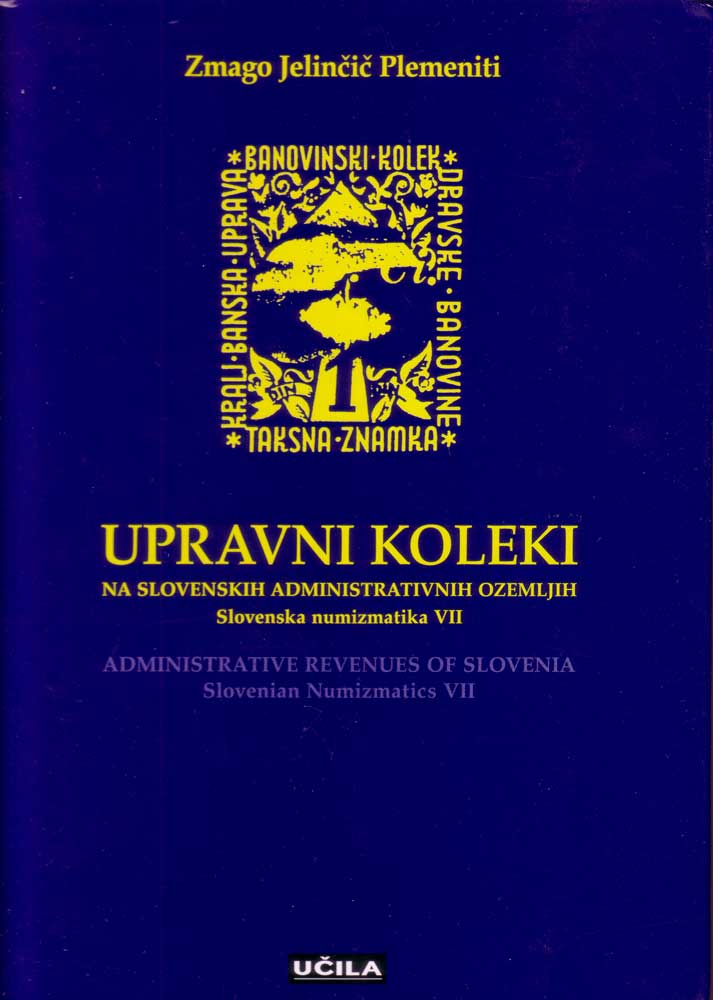
Mr. Igor Pirc us signals a new book: "Administrative Revenues of Slovenia" by Zmago Jelinčič Plemeniti
The 310-page A4 size and full colour most comprehensive catalogue of the administrative revenues of the former Yugoslav territory. Complete study from the first beginnings until the suspension of the administrative revenues. Approximate values of each stamp in Euros – almost 2000 examples.
The writer of the book is Zmago Jelinčič Plemeniti, specialist in revenues and numismatics, member of the Slovene parliament. The book was published by Učila Tržič, Slovenia in September 2010. The price of the book is 69,90 €, , then the postal service (stamps, envelope) makes alltogether 80 €. (Contact: ipirc711@gmail.com)
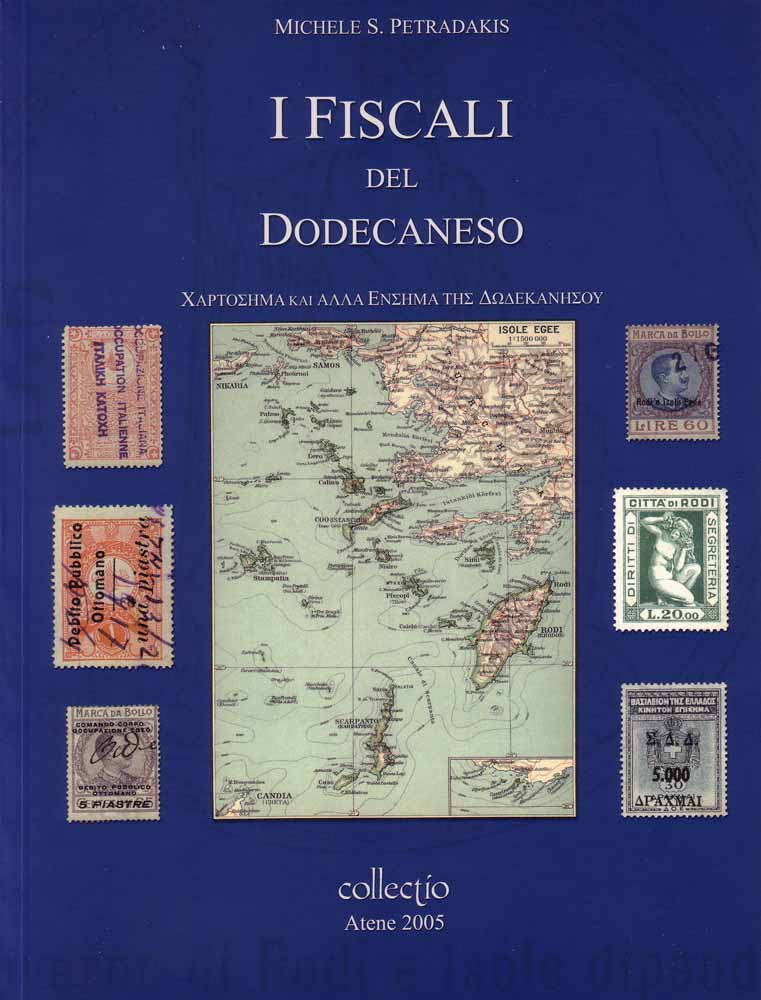
REVENUE STAMPS OF DODECANESE (I Fiscali del Dodecaneso)
by Michael S. Petradakis, in Greek and in Italian, Collectio Athens 2005, soft cover, color illustrations, 192 pp., 20x26, available from Alexander Galinos, Collectio, P.O. Box 3138, 10210 Athens, Greece at $45 each, ISBN 960-88597-0-0 Book review by Constantin Mattheos, Collectors Club Philatelists, Vol. 85, No. 5, 2006
Michael Petradakis, after his quite successful previous book on "Postal History of Aegean Islands, Italian Military Post Offices (1897-1943)", Athens 1991, offers his new book on revenue stamps of Dodecanese islands. This has been the result of a long and hard work, in which he presents the finest study on revenue stamps ever made in Greece.
The presentation is chronological and systematically divided into six parts: The Ottoman period; The Italian Occupation (1912-1923) of the islands; The Italian Possession (1923-1943); The municipality revenue stamps; The period after September 8, 1943; Italo-German occupation (1943-1945) and British Military Occupation (1945-1947); and finally, the sixth part deals with the Greek Administration of the islands (since 1947 up to now).
for each period, in addition to the background justifying the imposition of each revenue stamp, the writer makes a great effort to give the listing of all known revenue stamps, including the stamped papers and the bills, as well as their usages, and reproduces in color many available documents showing their usage.
Mr. Petradakis gives a quite understandable description and elucidation of the Ottoman (Osmanli) fiscal system and describes the imposition of the Great Powers of the Ottoman Public Debt and how it was working. In addition, he gives full list of the amazing high number of revenue stamps with color illustrations and evaluation, especially during the Ottoman period imposed from 1873 up to 1912, which affected all facets of business and everiday life of the islanders, like the Hejaz (Saudi Arabia) railway tax.
Such revenue stamps were for Passports, Proportional Fees, Newspapers and Advertisements, Wood Importation, Consulates, Court Fees, Rental Contracts, Foreign Affairs, Foreign Affairs-Receipts in Administration, Petitions, Pious Foundations, Receipts and acquittances, Transfers & Purchaces of Real Propoerty, Travel Permits, Lotteries, Immigration, For Passports Visas, Fixed Fees, for Patent Medicines, for Child Legalization, Animal Tax, Hunting Permit, Firearms License, Playng Cards, Market Duty, Religious Courts Stamps, Repairs License, Safe Conduct Pass, Tradesmen License, Fishing Permit, Theatre Tax, Judicial Fee for Employees of the Court, Deed Registration Fees, Museum Tax, Identity Cards, etc.
During the Italian Occupation, the Ottoman revenue stamps remained the same and the Ottoman Public Debt continued to be collected as before, given that, during that period the Dodecanese Island were considered Turkish territory under Italian occupation.
Since he Lausanne Treaty (1923), Rhodes and the other Dodecanese Islands became an Italian colony and the Italian revenue stamps were introduced in the islands.
Quite interesting are the municipal revenue stamps of Rhodes with their three different subsequent names (Podesteria di Rodi, Municipio di Rodi, Cita di Rodi), those of Castellorizo, Kos and Leros.
In a separate chapter, the author describes the use of postage stamps in lieu of revenue stamps and, inversely, in rare instances, the use of revenue stamps instead of postage stamps.
During the German occupation (1943-1945) the Italian revenue stamps remained in force, while during the British occupation (1945-1947) the Italian revenue stamps continued to be in use overprinted with handstamp "British Military Administration Revenue Office Dodecanese" or "British Mil. Admin>". After the union of the islands with Greece, at the beginning the Italian revenue stamps were in use overprinted in Greek with handstamps and later on Greek Revenue Stamps overprinted.
Lastly the autor cites a quite large bibliograpy and n extensive appendix of about 50 pages containing laws, decrees, documents and the like wich give the required support to the contents. In conclusion, in my opinion, the work of Michael Petradakis succesully completed the vacancy that existed in this field and it is the best book in its field. It is expected that an extensive summary will be published in English, and is promised by the author
----------****-----------
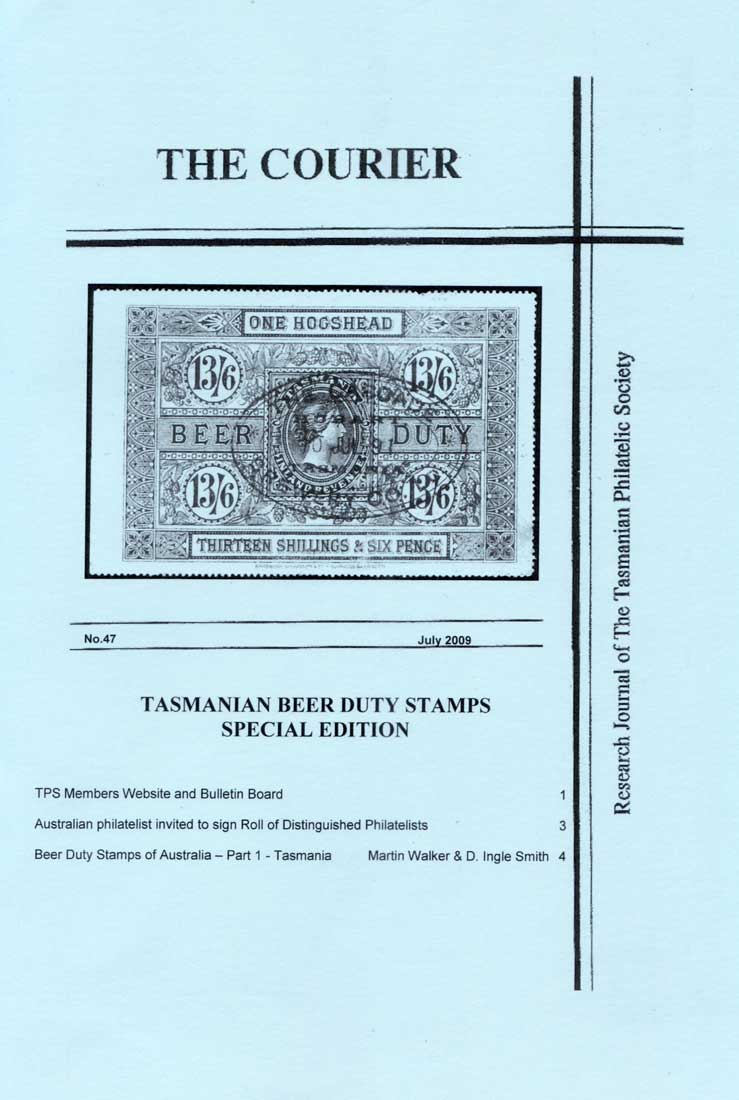
BEER DUTY STAMPS OF AUSTRALIA
PART 1: TASMANIA
The Courier No.47 Special Edition, July 2009
Martin WALKER and David Ingle SMITH
The authors are undertaking new annotated and illustrated listings of the beer duty stamps of Australia, both State and Commonwealth. The aim is to update existing catalogue listings and incorporate additional archival information and contributions from other collectors. This is especially the case for the Commonwealth issues from 1903 to 1918, when the stamps incorporated the names of the States and for the later period when there was a truly standard issue throughout Australia.
The plan is to separately publish listings for each State, wherever possible in conjunction with an appropriate specialist society. The Tasmanian Philatelic Society (TPS) has kindly published Part 1 as a Special Edition of The Courier, the Research Journal of the TPS. The 21 page study has seven pages devoted the methodology of the listing and a summary of State and Commonwealth legislation.
This is the first of a series of articles produced with the intent of demystifying the many and varied beer duty stamps issued by the Australian States and Commonwealth. It is appropriate that Part 1 is for Tasmania as that State was the first, in March 1880, to issue beer duty stamps in Australia Following the principles set by Martin Walker’s 2006 listing of South Australian revenues this listing was originally compiled from archival and legislative sources. When that was done, we began to assess the stamps held by today’s generation of revenue stamp collectors combined with previous attempts to catalogue them by collectors, researchers, dealers and publishers.
Issues are tabulated with columns for denomination, colour/variety, and earliest recorded date of use. Four columns of tick boxes then indicate the existence of the stamp as a proof (P),specimen (S), mint (M) or used example (U). These are indicated as items:
• not yet recorded.
• recorded as in the hands of collectors or the marketplace.
• recorded but only in archival collection(s).
What we continue to ask is for your help to further identify what was actually produced and what has survived of these fascinating issues. This article is to enable collectors and researchers to record their observations and report them back to the authors to produce a consolidated list, not only for Tasmania, but for all of Australia. The authors welcome all ideas, suggestions and contributions and can be contacted at the addresses below. All future contributors will be acknowledged unless they wish to remain anonymous, in which case we will certainly respect that wish.
For non-members of the TPS the Special Edition can be purchased at a cost of $A10.00, plus $1.10 postage within Australia and $4.50 for all overseas addresses. Payment can be by Australian cheque or by PAYPAL, payment by credit card is not possible. Orders either by post to The Tasmanian Philatelic Society, GPO Box 594, Hobart, Tasmania 7001, Australia or via the TPS web site www.tps.org.au and follow the links.
Beer Duty Stamps of Tasmania; Part 1 Tasmania will be available, in colour, on the TPS website although this is restricted to TPS members. It is our intention to incorporate additional information as it becomes available onto the TPS web site. Those interested in joining the TPS can obtain details of membership on www.tps.org.au. The annual subscription for overseas and for mainland Australian addresses is $A21.00.
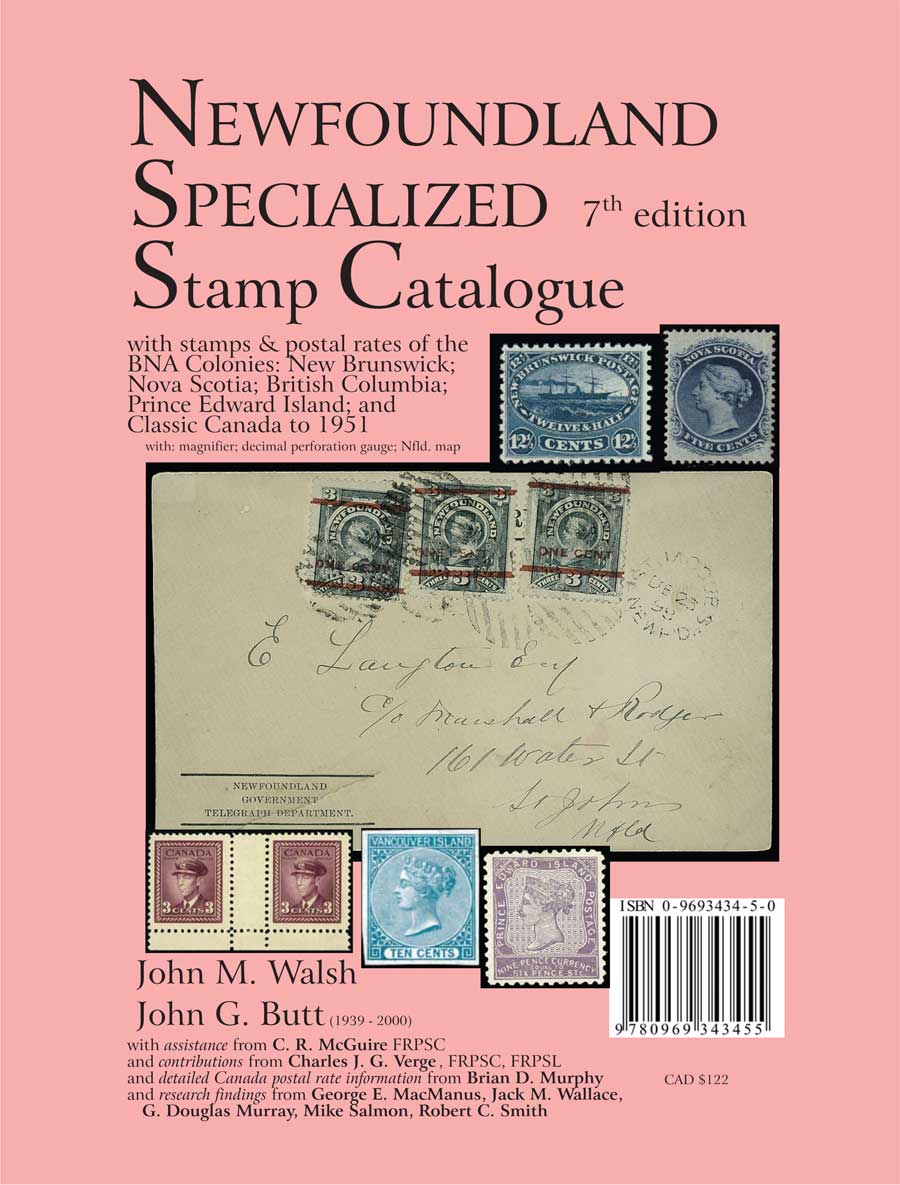
also providing stamps and postal rates of the BNA Colonies: New Brunswick, Nova Scotia, British Columbia, Prince Edward Island, and Classic Canada to 1951 (comes with magnifier, decimal perforation gauge, Nfld. map). by John M Walsh and John G Butt (1939-2000).
Published by Walsh’s Philatelic Service, 9 Guy Street, St. John’s, Newfoundland, Canada A1B 1P4.
ISBN 978-0-9693434-7-9; colour, spiral bound with protective clear cover, 640 pages,
6 ins. x 9 ins. or 153 mm x 228 mm. Retail price C $122- Orders accepted via: www.nfldstamps.com or by mail.
The latest edition of this catalogue continues to provide even more detailed information. The collector who collects pre- 1951 material pertaining to the colonies of British North America and Canada after 1867, will be hard pressed to find a more detailed listing. Catalogue listings terminate prior to the reign of Queen Elizabeth in 1951. Information provided is not what you will find in your general run of catalogues. The authors have created the listings based on each stamp die being assigned a whole number. The collector will find that colour shades, perforation differences and
paper types are listed as sub-numbers
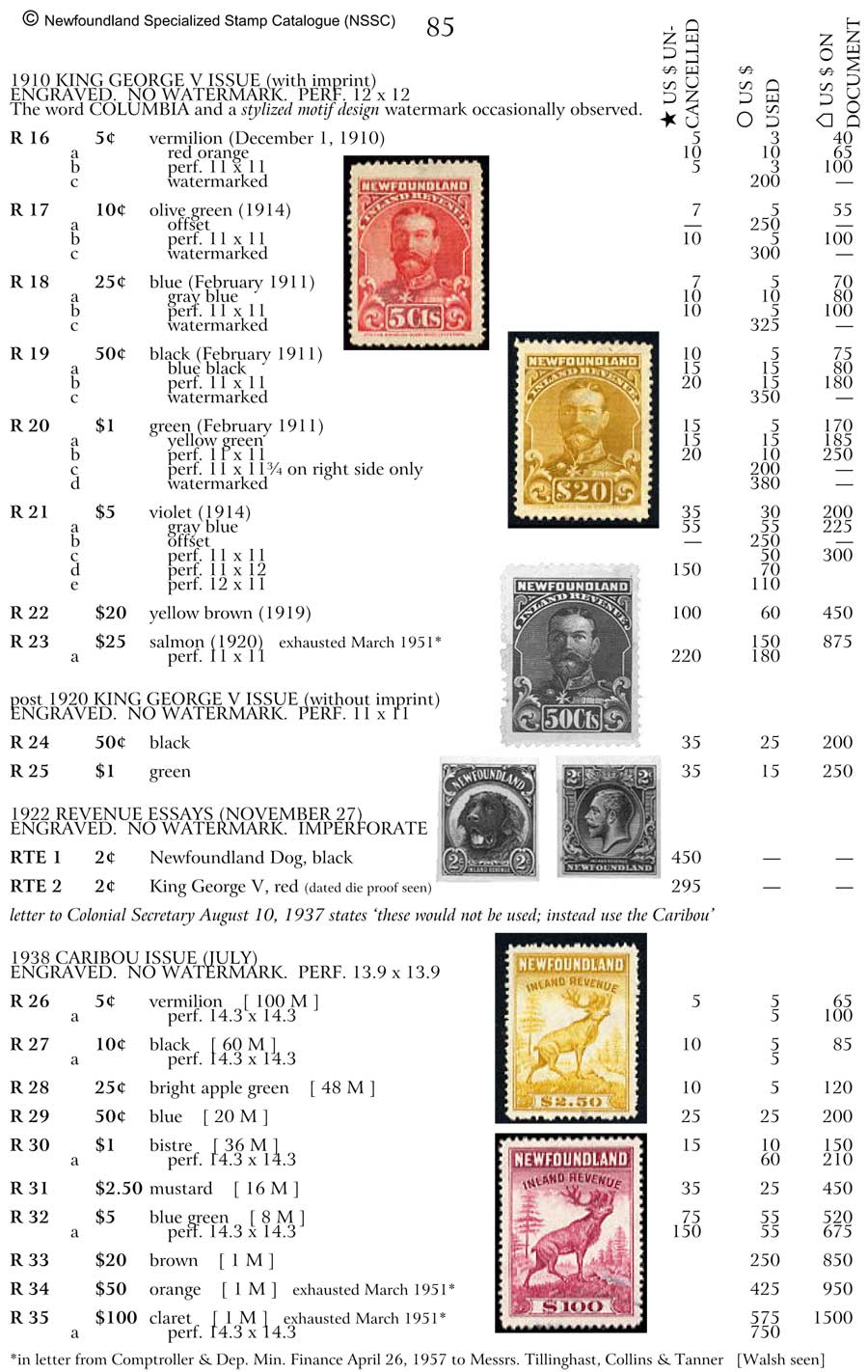
under the whole number which is contrary to the manner in which other cataloguers have followed. This system easily allows a collector who may wish to specialize in a specific stamp design to realize what is known to exist now for each stamp issue. Besides basic postage stamps, postage dues and airmail stamps a wide variety of related collectibles is presented. Thus, the collector will find sections on first flight covers, postal stationery and many other topics. In this edition an important feature is now added: a list of postal rates for each colony. In addition, within the Newfoundland revenu stamp section the revenue fee structure is now provided. Thus, the rates for judicial and civil legal documents are presented in concise table formats and cover the period from 1898 until the use of revenue stamp indicators was terminated in 1986. The presence of postal or revenue document rate structures in such a portable catalogue is an obvious enhancement to the collector’s ability to retrieve information.
Since the first edition was published in 1988 the catalogue has benefitted from contributions from collectors and philatelists too numerous to mention. With the untimely death of John G. Butt, the co-author, in 2000 such assistance has been indispensable as the catalogue grew and evolved beginning with a few members of the St. John’s Philatelic
Society meeting separately in each others’ homes to discuss Newfoundland stamps and related subjects of collecting. In this way, one section after another was added to consecutive editions of the catalogue, plus Professor Thomas Nemec’s article on the meaning of the designs on the Colony’s and later Dominion’s postage stamps after it initially appeared in a reduced form in the Encyclopedia of Newfoundland in 1993.
Recently, the catalogue has expanded to include the BNA Colonies and Canada from Confederation to the end of the reign of George VI. This was made possible in part by the assistance of C. R. McGuire, FRPSC and contributions from Charles J. G. Verge, FRPSC, FRPSL. In addition, information on Canadian postal rates was supplied by Brian D. Murphy and Robert C. Smith. Others have also contributed their research findings, such as George E. MacManus, Jack M. Wallace, Peter de Groot, G. Douglas Murray and Mike Salmon. Their efforts and publications have been acknowledged in the book. To them and anyone else who contributed sincere thanks is offered. This catalogue is highly recommended to collectors who want information on BNA instantly at their fingertips.
----------****-----------
“FISCALES ESPANOLES: ESTUDIO Y CATALOGACIÓN DE LOS TIMBRES FISCALES ESPANOLES INCLUIDA SU UTILIZACIÓN POSTAL”
A long-awaited and much needed book has finally seen the light —“Spanish revenues: Study and cataloguing of Spanish fiscal stamps, including their postal use”, by Luis Alemany, probably the most awarded Spanish philatelist (3 international FIP Grand prix, World champion in “Israel 2008”), a dedicated collector covering several competition fields and a member of the Royal Spanish Academy of Philately. The 470 page, full colour book is the first successful attempt to record the wealth of Spanish revenue stamps undertaken by a Spanish author since the former dealer Gálvez published his specialized Catalogue back in 1923, updating older works, such as those by Fulcher, Forbin and Carreras Candi, dating back to the 1910’s. In the long interval since then, no other reliable sources were available to the inquisitive collector or researcher.
The just published book provides the collector with a useful hybrid between the systematic catalogue and the research work, plenty of historical and legal information about every issue. Furthermore, it displays an array of Alemany’s valuable treasures, thus making the book into a showcase of one of the best Spanish revenues collections ever assembled. This first volume describes 37 categories of general use, official revenue stamps, among them consular, courts, customs, documentary, drafts, impressed duty, invoices, stock exchange, universities, war tax, and many others. A future second volume will concentrate on the so called para-fiscal or semi-fiscal stamps, such as charity stamps, municipals, private issues, professional colleges, corporations, etc.
To assembly this impressive amount of material, Alemany adopts a chronological approach and starts by the Book of Records (1852-57) stamps, the forerunners of adhesive revenue stamps in Spain. He lists the year of issue, the legal support and the estimated value of every stamp, distinguishing both fiscal and postal uses, proofs, essays and samples. The book includes several special features, such as the Spanish advertising revenues, forgeries and their identification, and the stamps issued by the Spanish communities historically enjoying fiscal privileges and distinctive revenue documentary stamps.
"Spanish Revenues: Study and cataloguing of the Spanish fiscal stamps, included their postal use"
By Luis Alemany
Published by EDIFIL
Bordadores, 8. 28013 Madrid, Spain https://www.edifil.es
Price: € 70.
----------****-----------
A new handbook of the earliest
Swedish revenue stamps
As a result of Swedish-Finnish bilateral cooperation, the first major handbook of early Swedish revenue stamps has been completed: Svenska beläggningsstämplar (eller Charta Sigillata) 1811-1880.
The new 100-page handbook was published by the Swedish Philatelic Federation (SFF) in early March, 2008, in the Swedish language. Writers of the book are Jukka Mäkinen of Helsinki, Finland, and Per Sundberg of Lulea, Sweden, both advanced collectors and specialists of the field. The book came in A4 size and full colour.
The earliest revenue stamps of Sweden are special and unconventional in several ways. They are documentary stamps, the largest in size in the world. They are imperforate and without gum, and were affixed on documents by sealing, embossing or stitching.
In Sweden, these very first stamps – used from 1811 up to 1880 – are generally known as beläggningsstämpel or Charta Sigillata stamps. In English the term could be revenue stamp, Charta Sigillata stamp or tax receipt label. In 1880 they were replaced in Sweden by more conventional smaller sized revenue stamps with perforations and gum.
The new publication covers all the nine Charta Sigillata issues. The first one, model 1811, was introduced 29 years before the first postage stamps of the world. Stamps of m/1811 were black and white. On white watermarked paper, there were added so called black stamps with an uncoloured embossed value stamp. The following eight issues were printed in splendid two-colour printing work, a revolutionary process at the time.
Such a large number of revenue issues was caused by repeated currency reforms carried out in Sweden in the late 19th century.
Another reason was the use of two parallel issues, at the same time, after 1847: the single stamps, which were used on documents as entires (m/1845, m/1858, m/1865 and m/1875) and the double stamps, which were used cut in half (m/1847, m/1858, m/1865 and m/1875). In this respect, the latter sets of issues are exceptional.
The new handbook of Swedish Charta Sigillata issues thoroughly introduces new research, which is published for the first time. Besides the main types of denominations, such knowledge as minor types, types of papers and watermarks, constant and temporary errors, as well as type tables of these and wide full colour illustrations are included. The book also is concerned with the stamp duty taxes of the era.
Concerning the first and most rare issue of 1811, a total of 2288 stamps from private and museum collections were researched. During the work, a new denomination of 40 sch + 1 RD, never before recorded, was found. As many as 99 of the 104 theoretically possible main types were registered. Five types remain still unrecorded. The watermarks were researched for the first time. They were divided to 16 types, known as four possible watermark positions.
The book includes an interesting story about an enormous collection of Swedish Charta Sigillata stamps (previously owned by Swedish collector Sven Svensson), which was discovered in Kungliga Myntkabinettet Museum of Stockholm by the writers during their research work. That unique collection was left by Svensson’s will in 1928, preserved for almost 80 years forgotten and intact, and now was studied to become part of modern philatelic knowledge. The philatelic importance of the newly rediscovered material was decisive when completing the handbook project.
The handbook Svenska beläggningsstämplar (eller Charta Sigillata) 1811-1880 is available from the Swedish Philatelic Federation for SEK 250 (postpaid to Scandinavian countries) / SEK 300 (postpaid to Europe and rest of the world). IBAN: SE63 3000 0000 0156 2310 4347 and BIC: NDEASESS.
For those people who want to purchase a copy of the book write to:
Sveriges Filatelist-Förbund, Box 91, SE-56822 Skillingaryd, Sweden, kansli@sff.nu, www.sff.nu
----------****-----------
Romanian Revenue & Cinderella Catalogue
1856 – 2006
In 2006 the first Romanian revenue stamp celebrated its 150th birthday!
On January 12, 1856 at Iasi in the Moldavian Principality during the reign of voivode Grigorie A. Gika, Ruling Ordinance no. 2 of the Stamp Tax Law was promulgated. The first revenue stamps were introduced in the form of stamped paper as used by the French at that time.
In November of the same year at Bucharest in the Walachian Principality, under the rule of Kaimakam, the same Grigorie A. Gika issued a stamp to supplement the bread price for impoverished families from 24 to 34 coins (a dry measure). This was the first Romanian social welfare stamp. On January 24, 1859 the Moldavian and Walachian Principalities joined to form the unitary, national state of Romania. In January 2006 to mark the anniversary of these historical events, the “Romanian Revenue & Cinderella Catalogue 1856 – 2006” by Mihai Cojocar was published.
The contents of the Catalogue apply the “SREV Revenue” (art. 3.1) provisions to Romanian revenue and Cinderella stamps. The Catalogue has 7 parts:
- First part: Romania imprinted & embossed stamps.
- Second part: National issue.
- The third part: Local issue.
- The forth part: Jewish.
- The fifth part: The national Cinderellas
- The sixth part: The local Cinderellas
- The seventh part: Unidentified issues.
The first part includes the issues of stamped sheets.
The second part includes the majority of national revenue stamps and is divided into 15 chapters according to their field of activity. Each chapter lists chronologically all the stamps known to have been issued.
The same procedure is used for parts 3 and 4 that list local emissions and those of the Jewish community in Romania.
Anticipating the future evolution of revenue philately, parts 5 and 6 include national and local Cinderellas.
Part 7 describes 5 stamps whose issuers are still to be identified.
The 2006 catalogue represents a revised version of that published in 2000 and presents the results based on the author’s personal research.
Where known, information regarding the purpose of the issue, its introduction and removal from circulation and a few words about the issuing institution are given. The amount of detail depends on the availability of the necessary background material.
The catalogue lists 6998 stamps as compared to 3743 in the 2000 issue. The entries for local issues have increased to 2727 from 1181 and there are 1688 digital photocopies as compared to 993. The great increase of the number of the stamps described in this catalogue in comparison to the previous issue, confirms that this field of revenue research and collecting is alive and well. The author would welcome any corrections and additions.
It is hoped that this catalogue, despite any possible imperfections, will help to enhance the ever-increasing interest of collectors and dealers for revenue stamps and associated material.
For further information relations contact Mr. Cojocar Mihai at email address cojocar_mihai@hidroconstructia.com
----------****-----------
*The FIP Commission for Revenues cannot assume any responsibility concerning the statements made on this page Books outside the Bureau members.
Therefore, we welcome different opinions and shall publish them in order to create a forum for discussion.